Technorati Claim Code: AGU6B8KGBW6J

If ever there was a tasty bread baked for instant gratification, this is it. I was having one of those “Good Lord I reeeeeeeally don’t even want to lift a finger today” kind of days, but my internal deadline was nagging at me about how “it’s been almost two weeks and your next post is due, and I don’t care that you were on vacation in the Bahamas because what kind of an excuse is that, anyway?” This is true, being away from the kitchen because I was too busy sipping Bahama Mamas from a coconut monkey head while lying on a boat deck trying desperately to change my skin color to anything darker than the vampiric translucence it was is not much of an excuse for a belated bread post, but nevertheless, I haven’t had much time.


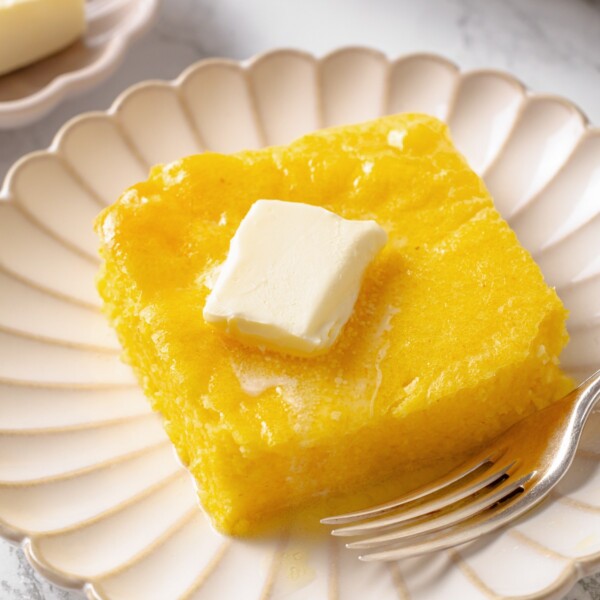
I found this bread in Joy under the “Corn Breads” section, and I was feeling mildly southern that day (I don’t know, maybe it was my subconscious wishing to be back in warmer climates) so my hankering + laziness led me to this spoon bread recipe. Heck, I didn’t even know what a spoon bread was, and I’m still not completely sure (the closest I got to an explanation was “corn souffle“), but it sounded like something warm and slightly gooey and cornmeal-y, and if it requires nothing more than a spoon and a mouth, I’m in.


Truth is, it wasn’t much more than a slightly softer version of regular corn bread, but the golden brown, crusty edges in combination with the melt-in-your-mouth buttery center was like eating one of those baked mac n’ cheeses where you crack off the burnt cheese on the end of the casserole dish and douse it in warm, melty cheese noodles and… egads, it’s good. And very, very easy to make, too. Perfect for a day when you’d rather be back on a tropical island drinking cocktails at noon, but instead you’ve got bread to bake.


Crusty Soft-Center Spoon Bread
courtesy of The Joy of Cooking
Makes 4 servings (which is a mighty-fine heapin’ helping, I’d say. I served mine to 8 with no complaints.)
Preheat oven to 375 degrees.
Sift together:
1/4 cup all-purpose flour
1 tbsp sugar
1 tsp salt
1 tsp double-acting baking powder
Add:
3/4 cup yellow cornmeal
Stir in until well blended:
1 beaten egg
1 cup milk
Melt in a high-rimmed 8 x 8-inch baking dish:
2 tbsp butter
Pour in the batter. Pour over the top:
1/2 cup milk
Bake 45 minutes or more, until good and crusty. (My overzealous oven completed its task in 38 minutes.)

This attraction to simplicity permeates into my thoughts about baking as well. I (almost) always refuse to eat dessert if it’s not homemade, and a good chunk of the reason I have been baking bread from scratch is because I am drawn to the idea of taking something so foundational to my daily diet and making it from tangible ingredients that I have personally divided and mixed and kneaded together into an edible (and hopefully delicious) item. I know where it came from and I know of what it is made, and I don’t need any additives or extra stimulants to make it better. Which is why, on any occasion, I would rather play a trivia game at the kitchen table with my 70-something year old grandmother and grandfather than sit on a couch and watch a rerun of “The Office” while eating Ho-Hos (which I would never do anyway, but the principle still stands).


Debrief: I think I’ll try the other method of shaping the bagels (not posted) to see if they come out less chewy. And I’ll leave off the seeds, or use one of the other topping ideas offered by Beranbaum. I learned through this process that I don’t care too much for chewy bagels.
Levy’s Bagels
Courtesy of The Bread Bible
Makes five 4-by-1 1/2 inch-high bagels
Dough Starter (Sponge) Ingredients:
1/2 tsp instant yeast (I converted this to a little less than 2/3 tsp for active dry yeast, as Beranbaum suggests using 1.25 the weight of instant yeast if using active dry)
1 liquid cup plus 2 tbsp water, at room temperature (70 to 90 degrees F)
1 1/2 cups King Arthur high-gluten flour, preferably, or bread flour
1. Make the sponge: In a mixing bowl or the bowl of a stand mixer, place the yeast, water and flour. Whisk about 2 minutes, until very smooth; scrape down the sides. The sponge will be very thick. Cover the bowl with plastic wrap.
Flour Mixture Ingredients:
(Optional) 1 1/2 tbsp unsalted butter
1 cup plus about 3 tbsp King Arthur high-gluten flour, preferably, or bread flour
1/2 tsp instant yeast (or 2/3 tsp active dry yeast)
1/2 tbsp malt powder or barley malt syrup (I used malted milk powder because that’s all I could find, and it worked for me)
1/2 tbsp sugar
1/2 tbsp salt
1/2 tsp black pepper
2. Combine and add the ingredients for the flour mixture: In a medium bowl, whisk together 1 cup of the flour, the yeast, malt, sugar, salt and pepper. Sprinkle the mixture lightly over the sponge; do not stir. Cover with plastic wrap and let stand for 1 to 4 hours at room temperature, or, for the best flavor development, 1 hour at room temperature and then refrigerated overnight, or up to 24 hours. (During this time, the sponge will bubble through the flour mixture in places; this is fine.)
3. Mix the dough: Add the butter if using it (I didn’t) and all but 2 tablespoons of the remaining flour and mix with the dough hook, starting on low speed (#2 if using a KitchenAid), mix until all the flour is moistened, about 1 minute. Raise the speed to medium (#4 KitchenAid) and knead for 10 minutes if using high-gluten flour, 5 to 7 minutes if using bread flour, adding the remaining 2 tablespoons flour toward the end if the dough doesn’t pull away from the bowl. It should be very elastic and smooth and should jump back when pressed with a fingertip. Empty it onto the counter and knead in a little more flour if it is tacky (slightly sticky) to the touch. More flour will make a heavier, chewier bagel, which some prefer.
4. Let the dough rise: Place the dough in a 2-quart dough-rising container or bowl, lightly greased with cooking spray or oil. Press the dough down and lightly spray or oil the top. Cover the container with a lid or plastic wrap. With a piece of tape, mark the side of the container at approximately where double the height of the dough would be. Allow the dough to rise, ideally at 75 to 80 degrees F, or 1 to 2 hours until doubled (this part took about 3 hours for me, and even then it didn’t fully double… hmm). Deflate the dough by firmly pushing it down. Give it an envelope turn and set it back in the container. Oil the top of the dough, cover it, and refrigerate it for at least 4 hours, or overnight for the most flavor. (If you want to make the bagels later, at this point the dough can be wrapped and refrigerated for up to 2 days. Let the dough stand at room temperature for 30 minutes before shaping.)
5. Shape the dough and let it rise: Set a sheet of the parchment or lightly floured towel on a countertop near the stovetop. (Alternatively, line the baking sheet(s) with parchment or floured towels and place the shaped bagels on them so you can move them easily when you are ready to boil them.) Transfer the dough to an unfloured counter. Cut the dough into five equal pieces. Allow the dough to rest for about 10 minutes.
(There are two shaping methods here. For the sake of avoiding writing a novel, I’ll only post the method I used.) To develop slightly more chewiness, roll each piece of dough on an unfloured counter into a 12-inch-long rope. Make a ring, overlapping the ends by 2 inches and joining them by pressing down and rolling on the overlap until it is the same thickness as the rest of the dough ring. There will be a 1-inch hole in the center. This technique results in rounder, slightly higher bagels with smaller holes. Allow the bagels to rise for about 15 minutes or until they puff slightly.
6. Preheat the oven: Preheat the oven to 500 degrees F 30 minutes before baking. Have an oven shelf at the lowest level and place a baking stone or baking sheet on it before preheating.
Water Bath and Toppings Ingredients:
2 tbsp molasses or 1/4 cup sugar (I used sugar)
1 tsp baking soda
Glaze and Toppings Ingredients:
2 large egg whites
1 tsp cold water
3 to 4 tbsp poppy, sesame or caraway seeds; kosher or sea salt; minced onions sauteed in vegetable oil; and/or dried garlic chips or dehydrated onions softened in hot water
7. Boil the bagels: Bring a large pot (about 9-by-4-inches high) of water to a boil. Stir in the molasses or sugar and baking soda until dissolved. With a skimmer, transfer the bagels, one at a time, to the boiling water, without crowding them; cook them in batches of 2 to 3 at a time so that they can swim around without touching one another. If they are slightly underrisen, they may sink at first but will then rise to the surface. Boil for 30 seconds to 2 minutes on each side, gently flipping them over with the skimmer; the longer time will make a thicker crust. Remove the boiled bagels, shaking off excess water over the pot and set onto parchment or the unfloured towel to drain, then move them, using a pancake turner, to the prepared baking sheet(s) or peel, after just 30 seconds to 1 minute, so that they don’t stick. The bagels will look wrinkled at this stage. Don’t worry — their appearance vastly improves on baking.
8. Glaze the bagels: Whisk together the egg whites and cold water to break up the whites. Pass through a sieve into a bowl, and brush each bagel with the glaze. Do not let the glaze drip onto the baking sheet or peel, or it will glue them down. Brush with a second coat of glaze and, if desired, sprinkle any topping of your choice evenly over the bagels. (If you are using seeds, lift each bagel with a thin pancake turner or your hand, and, holding it over the pan with the seeds, sprinkle some more seeds on top. This way, you don’t have any seeds that would burn on the baking sheet.)
9. Bake the bagels: If using baking sheets, place one sheet directly on the hot oven stone or hot baking sheet. If using a peel, slight the bagels onto the hot stone. Bake for 5 minutes. Lower the temperature to 450 degrees F and bake for 20 minutes. Turn off the oven, without opening it and let the bagels remain for 5 minutes. Then open the oven door and leave the bagels in the oven for 5 more minutes.
10. Cool the bagels: Transfer the bagels to a wire rack and cool completely.
Extra punches: The bagels keep well for 1 day at room temperature in a paper bag. For longer storage, wrap each in plastic wrap, place in plastic freezer bags, and freeze for up to 1 month. Thaw, still unwrapped, at room temperature.