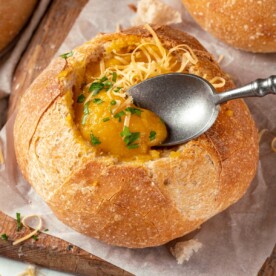
Sourdough Bread Bowl
This sourdough bread bowl recipe makes chewy, sturdy, and deeply flavorful bread, perfect for hearty soups and stews! An easy, yeast-free recipe that uses a biga and just 30 minutes of hands-on time.
Servings: 6 bowls
Ingredients
For the Biga (Night Before)
- 200 g water
- 80 g active sourdough starter
- 300 g bread flour
For the Dough
- 580 g biga all of the prepared biga
- 454 g warm water ?105°F / 16 oz
- 694 g bread flour
- 1 tablespoon kosher salt
Instructions
- Approximately 10–12 hours before mixing, place a clean medium bowl on a kitchen scale and press “tare” so it reads “0.” Add 200 grams of water, 80 grams of active starter, and 300 grams of bread flour to the bowl. Stir well until no dry spots remain. The mixture will be thick, so mixing by hand is often more effective than using a spoon. Cover and let sit at room temperature for 10–12 hours; the biga should more than double in volume.
- In a stand mixer bowl, add all of the biga, warm water (100-105°F), bread flour, and kosher salt. Mix on low speed with the dough hook attachment until all the flour and biga have been incorporated. Then, increase to medium speed and continue mixing to develop gluten for 5–6 minutes until the dough is smooth and elastic.
- Lightly oil a medium bowl, scrape the dough into it, cover the bowl with plastic wrap, and set in a warm spot to proof.
- Approximately 4 hours later, remove the plastic wrap. Toss some bread flour on top of the dough because this is the stickiest part. Lightly dust the countertop with bread flour, scrape the dough from the bowl using your bowl scraper, and dump out onto the floured countertop. Using floured hands and a bench scraper, divide the dough into 6 pieces; each will be approximately 280g.
- Working with one piece of dough at a time, fold each of the four corners into the center and flip seam-side down onto the surface. Using both hands dipped in flour, pull the dough round towards you, rotate 90°, and repeat until the top of the dough is pulled tight and the round boule sits tall on the counter. Towards the end of this process, the dough might start sticking to your hands; simply dip in flour and continue. This is the pre-shape. Cover with a clean kitchen towel and let the bench rest for 15 minutes.
- Flip the dough back over and repeat the folding and tightening process. Place each piece on a parchment-lined baking sheet, cover lightly, and proof in a warm spot.
- Approximately 2–2 ½ hours later, preheat the oven to 450°F (conventional) or 425°F (convection) with a Dutch oven or Challenger pan inside, including the lid.
- Trim the parchment slightly larger than the bottom of each bread bowl. Score the top of each boule with a razor blade, cutting an “X” at least ¼-½ inch deep. Carefully transfer the dough with the parchment to the hot pan. Cover and bake for 15 minutes, then remove the lid and reduce the oven temperature to 425°F (conventional) or 400°F (convection). Continue baking for an additional 15 to 20 minutes until the crust is golden brown. To bake a second batch, return the empty, covered Dutch oven to the oven and increase the temperature back to 450°F (conventional) or 425°F (convection). Allow the oven and pan to preheat before repeating the scoring and baking process with the next piece of dough.
- Remove the bread from the pan and let it cool on a wire rack for at least 1 hour. Using a paring or serrated knife, cut a circle from the top and remove some of the interior, leaving a ½-inch wall for soup. Save the removed bread for croutons, panzanella, or breadcrumbs.
Notes
How to mix by hand: Mix starter and water, then add bread flour and salt. Stir until a sticky dough forms; transfer to an oiled bowl and rest 1 hour. Fold once, then repeat for double folds. Rest 1 hour, repeat folds, then proof 2 hours before dividing.
Sourdough starter note: Since all the biga is used, feed your starter separately. You can use discard to make the biga, but never replace the biga with discard—this will throw off hydration and ruin structure
Nutrition
Calories: 610kcal | Carbohydrates: 123g | Protein: 20g | Fat: 3g | Saturated Fat: 0.4g | Polyunsaturated Fat: 1g | Monounsaturated Fat: 0.2g | Sodium: 1172mg | Potassium: 166mg | Fiber: 4g | Sugar: 1g | Vitamin A: 3IU | Calcium: 29mg | Iron: 2mg