
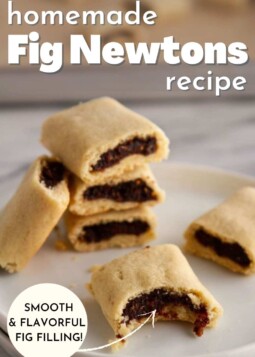
These fig newton cookies have a soft, cakey dough wrapped around a sweet, thick fig filling made from real dried figs. They get even better the day after you bake them, which makes them perfect for making ahead.


A Quick Look At The Recipe
This is a brief summary of the recipe. Jump to the recipe to get the full details.
Prep Time
1 hour 30 minutes
Cook Time
15 minutes
Cooling Time
1 hour
Total Time
2 hours 15 minutes
Servings
60 Cookies
Difficulty
Intermediate
Calories *
65 kcal per serving
Technique
Rolled dough, filled and baked
Flavor Profile
Sweet, fruity, lightly buttery, soft
* Based on nutrition panel
“I made these for a school snack party and every single one was gone in minutes. The tip about storing them in an airtight container with paper towels right away really does make them extra soft.”
⭐⭐⭐⭐⭐
Renata
Why You Will Love This Recipe
- Real fig filling. The filling is made from actual dried Mission figs, not a processed paste from a package. Blending them with applesauce and orange juice gives the filling a smooth, spreadable texture with bright, natural flavor.
- Soft and cakey texture. These cookies get noticeably softer and more cakey the longer they sit. Sealing them warm in an airtight container with paper towels lets the steam work into the dough overnight, which is what creates that soft, pillowy bite.
- A big batch for sharing. One recipe makes 60 cookies, so they’re ideal for lunchboxes, potlucks, or gifting. You can also bake one half of the dough and refrigerate the other half for a few days.
- Make-ahead friendly.
- A fun project that doubles as a snack. If you enjoy homemade snack recipes, these fit right alongside my Homemade Goldfish Crackers as a genuinely satisfying from-scratch project that’s worth every step.
Fig newtons were one of those snacks I always grabbed off the grocery store shelf without thinking much about them. Making them at home for the first time changed how I think about what a fig cookie can actually be.
They’re a wonderful treat to keep on hand all week and pack up beautifully for lunchboxes or an afternoon snack plate. If you love baking with figs, keep my fig bread or this fig olive oil cake in your back pocket.

Ingredients & Substitutions
- Dried Mission Figs: These are the heart of the filling, giving it that deep, jammy sweetness that makes a fig newton recipe taste like the real thing. Trim the stems before processing so the filling stays smooth and doesn’t have tough, woody bits. If you have extra, use them in these fruit and nut crackers!
- Unsweetened Applesauce: It blends into the fig filling to add body and a subtle natural sweetness without making the paste too wet. Don’t swap in sweetened applesauce, or the filling will tip too sweet and lose its balance.
- Fresh-Squeezed Orange Juice: I’ve used clementines in a pinch, and it was delicious!
- Unsalted Butter
- Granulated Sugar and Light Brown Sugar: Using both sugars together gives the dough sweetness with a hint of molasses depth from the brown sugar.
- Large Eggs: They bind the dough and give the cookies enough lift to stay soft and a little cakey rather than crisp. Beat them in just until incorporated — overmixing at this stage can make the dough tough.
- Vanilla Extract
- All-Purpose Flour: It gives the dough structure and makes it sturdy enough to roll out, pipe filling into, and wrap without tearing.
- Salt
Variations for Homemade Fig Newtons
- Date and Walnut Filling: Swap dried Mission figs for pitted Medjool dates, and add a handful of finely chopped, toasted walnuts before processing. The dates blend into a smoother, richer paste, and the walnuts add a subtle crunch to the soft cookie dough.
- Spiced Fig: Add a pinch of cinnamon and a pinch of ground cardamom to the food processor with the figs, then pulse. The warm spices deepen the filling’s natural sweetness without masking the fig flavor.
- Mini Bite-Size Format: Roll the dough strips to the same width but cut the finished cookies smaller, about 3/4 inch long instead of 1 1/2 inches. They’re easier to pack for lunches and hold together just as well as the full-size version.
- Chocolate! I bet these would be divine with the filling from this Povitica bread!

Professional Tips for Perfect Homemade Fig Newtons
- Chill the dough fully before rolling. The dough is too soft to work with straight out of the mixer and will stick and tear when you try to roll it thin. Refrigerate for a full hour to firm it up so you can roll it cleanly into a 14×9-inch rectangle.
- Keep one half of the dough refrigerated while you work the other. The dough warms up quickly at room temperature, and warm dough is much harder to roll into strips and wrap around the filling without splitting. Pull the second half out only when you’re ready for it, like I do.
- Wet your fingers before rolling the dough over the filling. Dry hands can tear the dough along the seam when you fold it over the piped fig paste. Damp fingers let you press and pinch the seam shut cleanly so the filling stays put during baking.
- Cut the cookies while the strips are still warm. Once the cookies cool completely on the pan, the dough firms up and tends to crack or crumble when you press a bench scraper through it. Cutting them within a few minutes of pulling them from the oven gives you clean, even squares every time.

How to Make Homemade Fig Newtons
Follow these step-by-step instructions to make soft, cakey fig newton cookies with a smooth, jammy filling and a tender dough that improves overnight. Find further details and measurements in the recipe card below.
Make the fig filling
Step 1: Trim the stems from your dried Mission figs, then cut them in half and add them to a food processor with the applesauce and orange juice. Pulse the mixture in short bursts until everything is roughly chopped, then scrape down the sides of the bowl with a spatula. Continue pulsing, adding a teaspoon of water at a time as needed, until the filling comes together into a smooth, thick paste that’s spreadable but holds its shape.
It won’t look perfectly uniform at first, and that’s completely normal — just keep pulsing and scraping until it smooths out just like when making these apple crisp energy bites.
Step 2: Transfer the filling to a piping bag. Spoon the fig paste into a large piping bag fitted with a 1/2-inch plain tip. The filling is dense, so press it down firmly and twist the top closed to get a good grip when you’re ready to pipe. Set it aside while you make the dough.
Make the Cookie Dough
Step 3: Cream the butter and sugars. In the bowl of a stand mixer fitted with the paddle attachment, or in a large bowl using an electric hand mixer, beat the softened butter with both the granulated sugar and light brown sugar on medium speed for 2 to 3 minutes. You’re looking for a mixture that’s noticeably lighter in color, smooth, and fluffy. If your butter was properly softened, the sugars will incorporate quickly, and the mixture will look almost pale and creamy.
Step 4: Add the eggs and vanilla. Beat in the eggs and vanilla extract until just incorporated. The batter may look slightly curdled for a moment after the eggs go in, which is fine — it will come back together as soon as you add the flour. Don’t overmix here.
Step 5: Mix in the flour and salt. Add the flour and salt and beat on low speed until the dough is well combined and pulls away from the sides of the bowl. It will be a soft, slightly tacky dough, not stiff or dry. Stop mixing as soon as you no longer see streaks of flour.
Step 6: Chill the dough. Turn the dough out and shape it into a large, flat disk about 1 inch thick. Wrap it tightly in plastic wrap and refrigerate for at least 1 hour. The dough is too soft to roll and work with at room temperature, so don’t rush this step. After an hour in the refrigerator it will be firm, smooth, and much easier to handle cleanly.
You can make the dough up to a day ahead and keep it refrigerated until you’re ready to roll and fill.
Step 7: Preheat your oven to 350°F and line a large rimmed baking sheet with parchment paper. This is a good moment to pull the chilled dough out and let it sit for just 2 to 3 minutes on the counter — not long enough to soften, just enough to make it slightly easier to roll without cracking at the edges
Roll the Dough
Step 8: Divide the chilled dough disk in half. Keep one half covered and back in the refrigerator while you work with the first. On a well-floured surface, roll the dough out to a 14×9-inch rectangle, using a bench scraper or pizza cutter to trim the edges into clean, straight lines. The dough is forgiving and rolls out smoothly once it’s properly chilled — if it starts to feel soft or sticky partway through, slide it onto a baking sheet and refrigerate for 10 minutes before continuing.
Cut and Fill the Strips
Step 9: Using your bench scraper or pizza cutter, cut the rolled rectangle into three strips, each about 14×3 inches. Pipe a line of fig filling down the center of each strip, roughly 1 inch wide and 1/4 inch tall, running the full length. The filling should hold its shape after piping — if it spreads or slumps, it may need another few minutes in the refrigerator to firm up.
Keep your piping pressure steady and work in one continuous motion from one end of the strip to the other for an even fill.
Roll, Seal, and Flatten
Step 10: Using wet fingers, roll each strip of dough lengthwise up and over the filling, then pinch the seam firmly to seal it closed. Roll the filled log over so the seam faces down, then press it gently with the palm of your hand to flatten it slightly. It should look like a compact, rounded rectangle rather than a round tube. Repeat with the remaining two strips, then transfer all three to the prepared baking sheet, spaced about 3 inches apart.
Bake
Step 11: Bake for 15 to 17 minutes, until the dough is baked through and just barely golden at the edges — you’re not looking for a deep golden color here. These should stay pale and soft. The tops will look set and dry to the touch, and the bottoms will have just a hint of color. Pull them at the lighter end of that range if you want the softest final texture.
Step 12: Cut and finish. While the strips are still warm, use a bench scraper or sharp knife to cut each one into squares about 1 1/2 inches long. Cutting them warm gives you cleaner edges and helps the cookies hold their shape. For soft, cakey fig newtons, transfer the warm cookies immediately to an airtight container with a layer of paper towel between each layer and seal the lid — the trapped steam works into the dough over the next several hours and gives you that classic soft, cakey texture. For a slightly drier, crispier result, let them cool completely on a wire rack instead. Either way, repeat the rolling, filling, and baking process with the second half of the refrigerated dough.
Recipe FAQs
Store them in an airtight container at room temperature for up to one week. The key trick is to layer paper towels between each layer of cookies. They actually taste best the day after they’re made, once they’ve had time to settle.
Yes, and it works really well. You can make the fig filling and the cookie dough up to a day ahead, store them separately in the refrigerator, and then roll, fill, and bake when you’re ready.
If you let the cookies cool completely on a rack before storing them, they’ll dry out a bit. For soft, cakey cookies, cut the strips into squares while they’re still warm and transfer them immediately to an airtight container with paper towels between the layers.
Dried Mission figs because they’re widely available and have a deep, jammy sweetness that works perfectly in the filling. If you can only find dried Calimyrna figs, those will work. The flavor will be slightly milder and less sweet, so taste the filling before piping and add a drizzle of honey if it needs.
Recommended Snack Recipes!

Appetizers & Snacks

Appetizers & Snacks
Appetizers & Snacks
Appetizers & Snacks
Homemade Fig Newtons

Ingredients
Fig Filling:
- 2 ½ cups dried Mission figs, stems trimmed
- ½ cup unsweetened applesauce
- 2 tablespoons orange juice, fresh-squeezed
Cookie Dough
- ½ cup unsalted butter, softened
- ½ cup granulated sugar
- ½ cup light brown sugar, packed
- 2 large eggs
- ½ teaspoon vanilla extract
- 2 ½ cups all-purpose flour
- ¼ teaspoon salt
Instructions
- Cut the figs in half and add them to a food processor along with the applesauce and orange juice. Pulse until roughly chopped, scrape down the sides, then continue pulsing, adding 1 teaspoon of water as needed, until the mixture forms a smooth, thick, spreadable paste. Spoon into a large piping bag fitted with a 1/2-inch plain tip and set aside.
- In the bowl of a stand mixer fitted with the paddle attachment, cream the butter and both sugars on medium speed for 2 to 3 minutes until smooth, light, and fluffy. Beat in the eggs and vanilla until just incorporated, then beat in the flour and salt until well combined.
- Shape the dough into a large, flat disk about 1 inch thick, wrap tightly in plastic wrap, and refrigerate for at least 1 hour.
- Preheat your oven to 350°F. Line a large rimmed baking sheet with parchment paper.
- Divide the chilled dough in half, keeping one half covered in the refrigerator. On a well-floured surface, roll the remaining half into a 14×9-inch rectangle, trimming the edges with a bench scraper or pizza cutter to form clean, even sides.
- Cut the rectangle into three 14×3-inch strips. Pipe the fig filling down the center of each strip, about 1 inch wide and 1/4 inch tall. Using wet fingers, roll each strip of dough lengthwise over the filling, pinch the seam to seal, then roll so the seam faces down and press gently to flatten slightly.
- Transfer the filled strips to the prepared baking sheet, spaced about 3 inches apart. Bake for 15 to 17 minutes until the dough is baked through and just very lightly golden.
- While the strips are still warm, cut them into squares about 1 1/2 inches long. For soft, cakey cookies, immediately transfer them to an airtight container with paper towels between each layer and let sit for at least 6 hours. For a slightly drier result, cool completely on a rack before storing.
- Repeat steps 5 through 8 with the second half of the dough.
Notes
Technique: Cut the baked strips into squares while they’re still warm, not after they’ve cooled. Transferring them immediately to an airtight container traps the steam, which is what gives the cookies their soft, cakey texture.
Measuring: Measure your flour by spooning it into the measuring cup and leveling it off — packed flour will make the dough stiff and harder to roll into clean rectangles.
Storage: Store in an airtight container at room temperature for up to one week, with paper towels layered between each layer of cookies to keep them soft. They taste best the day after they’re made.
Nutrition
Nutrition information is automatically calculated, so should only be used as an approximation.
 Like this recipe? Rate & comment below!
Before You Go
I hope this fig newton recipe becomes a regular in your baking rotation. Browse our snack and appetizer recipes or make these homemade twix bars next!






If you wanted to make a flavor, such as blueberry, how would you do that?
Hi Stephanie I love where your heads at! Simply swap the fig filling for a blueberry one: cook 2 cups of fresh or frozen blueberries with 2-3 tbsp sugar and a squeeze of lemon juice over medium heat until thick and jammy, about 10-15 minutes. Let it cool completely before filling. The dough stays exactly the same! You could use this method with almost any berry or fruit — raspberry and strawberry work beautifully too! ~GVD team
Great final product! The mission figs took some looking for and costed $9, and still had to add some Turkish figs to have enough. I used a chopped up apple with a little water replacing the apple sauce, and lemon juice instead of orange juice. I do with what I have. Turned out great. I used a baggy with the corner cut for my pastry bag. Worked fine.
This is the spirit of baking we love! And a chopped apple with water for applesauce, lemon for orange juice, a zip-lock bag for a pastry bag, you made it work with what you had and still got a great result! Thanks so much for sharing your substitutions, other readers will find them really helpful! ~GVD team
I never thought I would have used the Figs in my pantry. Great recipe! Love every bite.
Hi Sandi! I’m so glad to hear that, thank you for taking the time to come back and let us know. Happy baking, and hope you enjoy it many more times! ~gvd team
Really enjoyed making this recipe to use up my fig spread but what we loved the most is the dough itself. Delicious! Going to try to make this dough into another completely different ? Thank you!
Hi Josie! I love hearing that, the dough is such a treat on its own. I’d be so curious to hear what other creations you make with it, and happy baking! ~gvd team
These are so delicious! I hate buying store bought because of the junk in them and these are an even better and tastier option! I cannot wait to make again and play around with what I put in the filling!
Oh hooray, Cathleen! I am so happy you enjoyed them! Thank you so much for taking the time to come back to comment and rate! Let me know what other fillings you try! I love the raspberry newtons myself 🙂 ~Lindsey
Never in a million years would I have thought I’d make my own fig newtons. Your recipe was great – couldn’t have been happier. Thanks!!!
Hi Michael! We love to hear it! Thanks for taking the time to come back and rate/comment! Always makes our day. ~gvd team
Hi, Stephanie—I’ve got the dough all made and am wondering if there should be some kind of leavening like baking powder or soda. All the other recipes I previewed had something like that.
Hi DesertD, There is no leavening here, because we don’t want these to be puffed up in any way.
Any tips for using a gluten-free flour? Thanks.
Hi Ellen, I think you could easily swap the flour here for an all-purpose 1:1 gluten-free flour and the results would be similar.
I can’t wait to make these! I loved these as a kid and didn’t think of them as anything other than cookies. Aren’t they? So, which way do you prefer them after baking? Which would seem like the originals? Put into a container right away or allowed to cool? Thanks for this!
Hi Colleen, I’m excited for you to try them! I personally preferred the ones that were put into the container right away — they were soft and cakey, just like the store-bought variety, whereas the cooled ones were a little crunchier. Enjoy!